








This Directive is designed to enhance consumer protection through a series of targeted measures, primarily addressing unfair commercial practices—whether actual or potential—that could mislead consumers or hinder their ability to make sustainable commercial choices. The Directive specifically targets practices such as misleading environmental statements (“greenwashing”), premature obsolescence of goods, deceptive information regarding the social or ethical attributes of products or businesses, and the use of sustainability labels that lack transparency or credibility.
The Directive must be transposed into national law by March 27, 2026, and its provisions will become effective as of September 27, 2026. Upon transposition, there will be a significant increase in consumer protection, primarily through major amendments to the Consumer Code. This will also increase the exposure of businesses to potential litigation and regulatory sanctions, particularly concerning green claims. As a result, it is crucial for companies to promptly take necessary steps to ensure their corporate communications and marketing strategies fully comply with the new regulatory framework. Such diligence is essential for prudent management of the elevated risk environment introduced by the Directive.
Key areas of innovation and legal exposure
Directive 2024/825 broadens the scope of unfair commercial practices as outlined in Annex 1 of Directive 2005/29 by introducing explicit prohibitions against greenwashing. Notable innovations include the introduction of new statutory definitions and expansion of what constitutes misleading commercial practices.
New statutory definitions
- Environmental claim (“green claim”): Any communication—including symbolic or graphic elements—that suggests a positive environmental impact, or more specifically asserts or implies that a product, product category, brand, or economic operator has a positive or neutral impact on the environment, is less harmful to the environment than others, or has improved its impact over time.
- Sustainability label: Any trust mark, quality mark, or equivalent, whether public or private and voluntary, intended to distinguish and promote a product, process, or business based on its environmental or social characteristics—or both—excluding marks required under Union or national law.
- Certification system: A third-party verification system that certifies a product, process, or business complies with certain requirements, allowing the use of a corresponding sustainability label.
New misleading commercial practices
The Directive identifies new misleading commercial practices, regardless of the accuracy of the information, if the average consumer is misled or may be misled about:
- Environmental or social characteristics of a product
- Aspects related to product circularity, such as durability, reparability, or recyclability
- Any environmental claim about future performance that lacks clear, objective, publicly available, and verifiable commitments established in a detailed and realistic implementation plan. This plan must include measurable objectives, precise deadlines, resource allocation, and periodic verification by an independent third party, with results accessible to consumers.
New misleading omissions
When a professional provides a product comparison service and communicates information on environmental or social characteristics, or aspects related to circularity, the following constitutes a misleading omission:
- Failure to provide relevant information, such as the method of comparison, the products and suppliers compared, and the measures taken to keep the information current.
Inherently misleading practices
The legislative decree under approval will classify the following as inherently misleading commercial practices:
- Displaying a sustainability label not based on a certification system or not established by public authorities.
- Making a generic environmental claim without being able to demonstrate recognized excellence in environmental performance relevant to the claim.
- Making an environmental claim about an entire product or professional activity when it only pertains to a specific aspect or element.
- Asserting, on the basis of greenhouse gas emissions offsetting, that a product has a neutral, reduced, or positive impact on the environment in terms of greenhouse gas emissions.
Jurisprudential guidelines in Italy
Recent Italian case law has provided guidance on the application of these principles. For example, on July 25, 2025, the Milan Court, in a collective injunctive action pursuant to Article 840-sexdecies of the Italian Code of Civil Procedure, found several green claims made by a company to be misleading commercial practices under Article 21 of the Consumer Code. The Court held that these claims were “unproven and unverifiable propositions” that conveyed the impression that the company’s activities were conducted according to particularly high standards of sustainability and environmental protection, or even that its activities were “zero impact.”
Examples of claims deemed unfair commercial practices by the Milan Court include:
- “This company adheres to high standards of environmental and social positive impact”
- “We are committed to following the highest standards of sustainability, transparency, and fairness. We are here to do our part and build a better future for everyone.”
- “Our philosophy extends to the entire supply chain, through the choice of local suppliers with zero-impact production standards, sharing the common goal of reducing unnecessary consumption and enhancing the local area.”
- “Knitwear ZERO IMPACT”
Similarly, the Court of Gorizia in 2021, in a case between Alcantara SpA and Miko srl, found that “green environmental declarations” must be clear, truthful, accurate, and not misleading, and must be based on scientific data presented in an understandable way. Generic messages such as “natural choice, environmentally friendly, the first and only microfiber that guarantees eco-sustainability throughout the entire production cycle, ecological microfiber” were deemed prohibited, as they create a green image without specifying which policies actually allow for greater environmental respect and reduced impact.
Potential impact of the directive on green claims
In light of Directive 2024/825 and prevailing case law, the following general guidelines emerge:
- Green claims are generally admissible if they are specific, verifiable, measurable, and supported by evidence.
- Claims that are generally prohibited include:
- Generic claims
- Absolute claims (e.g., “zero impact,” “neutral,” “100% green”)
- Claims based solely on compensations
- Claims not supported by certifications
- Comparative claims without clear methodology
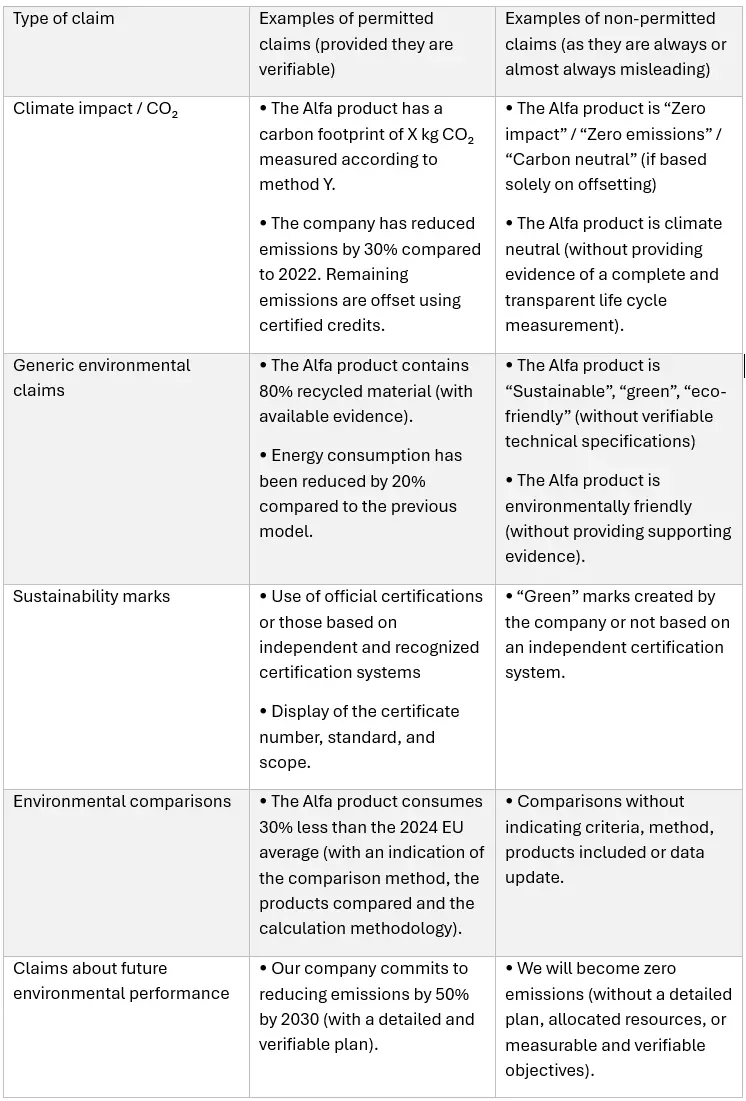
The table below provides illustrative examples of claims that may be permissible under certain conditions and claims that are generally not permissible. These examples are theoretical and must be evaluated on a case-by-case basis.