











Did you know that 20,000 years ago the water in the Gulf was shallow enough to walk across in certain parts? But as ice sheets began to melt, global sea levels rose substantially.
A geological and commercial crossroads
The Strait of Hormuz, a narrow waterway that connects the Gulf and the Gulf of Oman, is regarded by National Geographic as a geological wonder* and sits at the meeting point of the Arabian and Eurasian tectonic plates. Their collision around 35 million years ago helped shape both the surrounding mountains and the basin that later filled to create the Strait.
Beyond its geological significance, the Strait is one of the world’s most important commercial waterways, with around 20% of global oil and liquefied natural gas passing through it.
On 28 February 2026, a series of strikes was launched against Iran, the latest in a long pattern of tensions in which the Strait has been used as a strategic pressure point, from the Tanker War in the 1980s, threats to close it in 2011-2012, to more recent ship seizures over the last decade.
As is clear, the position remains uncertain, truce or no truce. It is also quite likely that the effects of what began in February are only now beginning to be fully felt. History suggests that the significance of the Strait means that further disruption cannot be discounted.
The impacts of the current conflict in Iran on areas such as insurance, sanctions and infrastructure are covered in more detail in our recent report, Conflict without borders and the illusion of distance. This article examines the litigation risks arising from the current situation surrounding the Strait, with further articles to follow in this series on fraud and investigations, and arbitration, in more detail.
The data shows the extent of the shock
Data and analytics from Dun & Bradstreet show the breadth of exposure, with more than 44,000 businesses across 174 economies linked to at least one affected shipment within weeks of February 2026.
Global logistics flows have been materially disrupted, with a sharp collapse in shipping bookings into the Gulf and a corresponding spike in cancellations. These disruptions are only partially offset by diversion to alternative routes and ports. Some vessels are being rerouted via the Cape of Good Hope – adding at least 3,000 nautical miles – and resulting in significant delays and additional costs for already constrained supply chains.
The figures below illustrate the scale of the decline in logistics bookings, the increase in cancellations and the limits of rerouting capacity, together with the extended transit times resulting from diversion away from Hormuz.
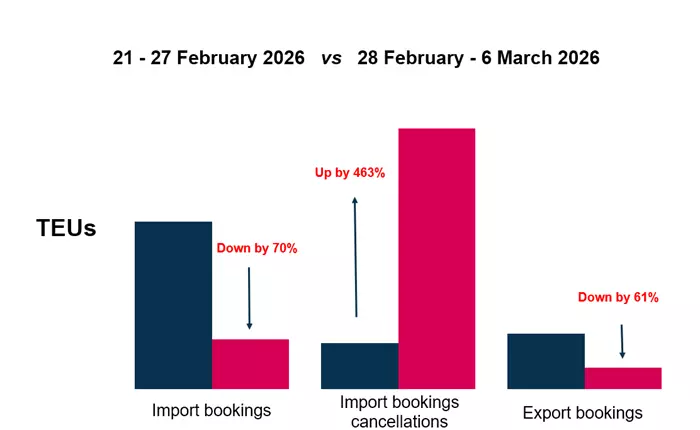
Source of data: Strait of Hormuz Disruption 2026: Oil & Supply Chains
What parties should be thinking about
From a litigation perspective, when disruption of this kind affects the supply chain, there is a heightened risk of contractual disputes, whether arising from failed or delayed performance, the allocation of additional cost or the allocation of risk more generally.
So, what should affected parties be doing now?
Understand your contract(s), focusing in particular on:
- The core provisions, including insurance, risk allocation, force majeure, frustration (impossibility or radical change), dispute resolution and jurisdiction (national courts, arbitration) and taking account of governing law (whether English law or another legal system).
- Where multiple agreements apply (e.g. supplier, manufacturing, distribution), read them together and look for any inconsistencies (do they provide for different laws, dispute resolution mechanisms or risk allocation, do different terms and conditions apply).
Act early and comply with contract mechanics:
- Check notice provisions, timing requirements and any conditions precedent (do you need to take particular steps before exercising a contractual right, and do those steps need to be taken by a particular date?), and ensure strict compliance without inadvertently triggering notices, affirming contracts or waiving rights.
- Preserve evidence and maintain a clear audit trail (e.g. delays, routing decisions, market conditions and costs) and document mitigation steps. Ensure that relevant and appropriate correspondence is sent in a timely manner. Expect your actions to come under the microscope in any proceedings before a court or tribunal.
Define your dispute strategy early, including:
- How any claim or defence will be framed, advanced and evidenced, taking into account any pre-action or escalation requirements.
- Ensuring internal alignment by identifying and retaining key documents (you will likely need to suspend any auto deletion document policies in the run up to litigation), and identifying key personnel and potential witnesses, including those with specialist knowledge.
- As a general matter, don’t dive headfirst into litigation or asserting rights prematurely – gather the factual background, secure the evidence, and invite a dialogue with your counterparty without waiving rights and with the benefit of legal advice. Do not assume that mechanics that have one effect under one applicable law (such as “without prejudice”) will operate under all legal systems.
What some past cases tell us
An expected line of argument might go something like this: A seller agrees to supply fuel from the Gulf to a European buyer at a fixed price. Following the disruption in and around the Strait of Hormuz, freight rates and war risk insurance premiums rise sharply and ships are diverted, adding weeks to transit times. The seller refuses to ship, arguing that the disruption entitles it to relief under the contract’s force majeure provisions or, alternatively, that the contract has been frustrated. The buyer purchases replacement fuel from another supplier at a much higher price and commences proceedings claiming £2 million in damages, representing the difference between the contract price and the replacement price (“loss of bargain” damages).
Much has been written on the concept of force majeure and risk mitigation elsewhere. The same is true of frustration, which we sum up here by saying: it is narrowly construed and rarely applies in practice. Tsakiroglou & Co Ltd v Noblee Thorl GmbH [1962] AC 93 (no frustration on Suez Canal closure because shipment via the Cape of Good Hope remained possible and did not render the contract fundamentally different). As regards force majeure, one’s chances of success depend entirely on the contract, and therefore (unsurprisingly) the starting point is the ordinary meaning of the words used. NKD Maritime Ltd v Bart Maritime (No 2) Inc [2022] EWHC 1615 (Comm) (no force majeure because Covid restrictions may have delayed or hindered performance, but they did not amount to an “inability” to perform). In other words, the hypothetical facts above appear to favour the buyer, leaving the seller with an uphill battle.
More recently, a case reported to be the first major litigation in the UK arising out of the current conflict highlights how global disruption can generate downstream legal consequences. Mercuria Energy Trading SA v Baltic Exchange Information Services Ltd (2026) Case No. FL-2026-000015 is scheduled for trial in October, and involves a commodities trader (Mercuria), alleging that the effective closure of the Strait of Hormuz led to distorted freight pricing, as a widely used industry benchmark continued to be published even though the underlying shipping route had effectively ceased to function. This allegedly caused losses on both physical shipping contracts and related financial positions. The case may be an early indicator of claims to come, particularly given Mercuria’s CFO has already warned of a wider wave of disputes, including force majeure claims.
A brief word on arbitration
Arbitration may be particularly relevant where supply chain disruption cuts across jurisdictions, contracts and counterparties. It is a consensual forum, so the starting point is always the dispute resolution clause itself: what disputes are covered, what seat and rules apply, whether there are escalation steps or preconditions to commencing proceedings, and whether the clause is consistent across the wider contractual suite. Where contracts sit within a chain of supply, inconsistencies in forum, governing law or notice mechanics can themselves become a source of tactical difficulty.
The potential advantages are not abstract. In a dispute involving freight, energy supply, insurance, sanctions or complex routing decisions, parties may value confidentiality, enforceability, procedural flexibility and the ability to appoint decision-makers with relevant sector or technical experience. Arbitration may also offer practical tools where time is critical, including emergency arbitration, expedited procedures or interim measures, depending on the applicable rules and seat. Those options should not be considered only at the point relations have deteriorated. During times of conflict and turmoil, parties should be considering whether their contracts allow them to preserve rights, seek urgent relief, consolidate related disputes or align across connected agreements. As with litigation, the foundations are largely factual: preserve documents, record the commercial rationale for mitigation decisions, capture contemporaneous evidence of delay, additional cost and market conditions, and take legal advice before sending notices or adopting positions that may later be scrutinised by a tribunal.
Looking ahead
We have only scratched the surface. As the fallout from February continues to work its way through global supply chains, further disputes seem likely. How those disputes are framed and resolved will be closely watched.
In the next two parts of this series, we will explore these themes in greater detail, first focusing on fraud, misrepresentation and related investigations, and then on arbitration and the strategic tools available to parties, including the strategic use of interim measures and procedural tools in fast moving supply chain disputes.
DWF acts for clients in disputes arising from supply chain disruption, delay, force majeure events and wider contractual uncertainty. If you would like to discuss how the issues considered in this article may affect your contracts, supply chain or dispute strategy, please reach out to the authors below.
* Reference: Why the Strait of Hormuz is a geological wonder | National Geographic